International wellness companies are no longer building factories. They are calling India.
Walk into any health food store in London, Toronto, Dubai, or Los Angeles today and you will find shelves stocked with Ashwagandha capsules, Turmeric extracts, Triphala powders, and Ayurvedic wellness blends carrying Western brand names. What most consumers do not realise is that a significant portion of these products were formulated, manufactured, tested, and packaged in India — often in certified facilities that have been operating for decades.
This is the private label Ayurveda boom. And it is reshaping how the global wellness industry works.
What Is Private Label Ayurvedic Manufacturing
Private label manufacturing is a model where an overseas brand contracts an Indian manufacturer to produce products under the brand’s own name and packaging. The brand owns the label. The Indian manufacturer owns the expertise, infrastructure, and production capacity.
For international wellness companies, this model solves three problems simultaneously. It eliminates the capital requirement of building a manufacturing facility. It removes the regulatory complexity of sourcing and processing herbs in a foreign country. And it dramatically shortens the time from product concept to market launch.
For Indian manufacturers, it opens a direct channel to global retail shelves without requiring their own international distribution network.
The result is a partnership model that is growing faster than almost any other segment in the global nutraceutical industry.
The Numbers Behind the Boom
The scale of this shift is not anecdotal. The global nutraceutical market was valued at approximately USD 454 billion in 2023 and is projected to reach USD 693 billion by 2030, growing at a CAGR of around 7 percent. Within this, the herbal supplement segment is expanding faster than synthetic alternatives as consumer preference shifts toward plant-based wellness solutions.
India’s AYUSH sector crossed ₹80,000 crore in domestic market value and Ayurvedic product exports have been growing steadily year on year. The government’s push through AYUSH export promotion councils and alignment with international GMP standards has made Indian manufacturers increasingly credible to overseas buyers.
More significantly, a 2023 survey by the American Botanical Council found that herbal supplement sales in the United States reached record levels for the third consecutive year. European and Gulf markets are showing similar trajectories. This demand is not being met by local Western manufacturing. It is being met largely by India.
Why International Brands Choose Indian Manufacturers
The decision by a brand in Germany or Canada to source from India is not simply about cost, though cost competitiveness remains real. The deeper reasons are more structural.
India possesses something no other country can replicate at scale — a combination of ancient formulation knowledge, domestic botanical raw material access, a large pool of trained Ayurvedic pharmacists and production specialists, and an established regulatory framework under the Drugs and Cosmetics Act and AYUSH Ministry guidelines.
When an international brand wants to launch an Ashwagandha sleep capsule or a Triphala digestive blend, they need a manufacturer who understands not just the chemistry but the traditional rationale behind the formulation. That depth of knowledge exists almost exclusively in India.
Certified Indian manufacturers offering Ayurvedic third party manufacturing for export can provide complete end-to-end solutions — from custom formulation development and stability testing to multilingual labelling, export documentation, and bulk dispatch — in a single partnership.
What Global Brands Actually Look For
Not every Indian manufacturer qualifies for private label export partnerships. International buyers have become considerably more sophisticated in their vendor selection process.
The baseline requirements today include GMP certification, valid manufacturing licences under AYUSH, batch manufacturing records, certificate of analysis for every batch, heavy metal testing compliance, and proper stability data. Buyers from regulated markets like the USA, EU, and Canada additionally require documentation that aligns with their own national regulatory frameworks.
Beyond compliance, buyers assess production capacity, lead time reliability, minimum order flexibility, communication responsiveness, and the manufacturer’s track record with previous international clients.
This is where established manufacturers with decades of operational history have a clear advantage over newer entrants. Experience with export protocols, familiarity with international quality expectations, and existing relationships with freight and customs partners all reduce risk for the overseas brand.
The Role of Legacy Manufacturers
There is a particular category of Indian Ayurvedic company that is exceptionally well positioned for this moment — manufacturers who have been operating for multiple decades, who built their foundations on classical Ayurvedic formulations, and who have since modernised their facilities to meet contemporary GMP and export standards.
These companies hold something that cannot be acquired quickly — institutional knowledge of formulations like Bhasmas, Arishtas, Asavas, and complex multi-herb compounds that require years of production experience to execute correctly.
According to Prabhdeep Singh Chawla, a third-generation Ayurvedic manufacturer and export specialist based in Amritsar, the private label model is fundamentally changing who benefits in the industry.
“Twenty years ago, only large corporations could access international markets. Today, a certified manufacturer with the right documentation and production systems can supply a wellness brand in Europe or North America directly. The private label model has democratised Ayurvedic exports — but it has also raised the bar on quality and compliance. Only manufacturers who take both seriously will last in this space.”
Product Categories Driving Private Label Demand
Not all Ayurvedic products are growing equally in international private label demand. Certain categories are seeing particularly strong interest from overseas brands.
Adaptogen formulations featuring Ashwagandha, Shatavari, and Brahmi are commanding premium positioning in stress and cognitive health segments across Western markets. Digestive wellness blends anchored by Triphala, Trikatu, and Hingvastak are gaining ground as gut health becomes a mainstream consumer priority. Immunity support products combining Giloy, Amla, Turmeric, and Tulsi saw significant adoption during the pandemic years and have retained much of that market presence.
Joint health formulations using Shallaki, Guggul, and Nirgundi are finding buyers in ageing population markets across Europe. And classical formulations including Chyawanprash, Brahmi Vati, and Arjun Ksheerpak are being repackaged in modern formats — capsules, effervescent tablets, and sachets — for markets that want traditional efficacy in contemporary delivery systems.
Each of these categories represents a product line that an established Indian manufacturer can produce under private label within a relatively short development and approval timeline.
Jammu and Kashmir’s Untapped Botanical Wealth
Within India’s herbal manufacturing landscape, Jammu and Kashmir occupies a uniquely powerful position that remains significantly underutilised from a commercial standpoint.
The region sits at the intersection of three distinct botanical zones — the subtropical Shivalik foothills around Jammu, the temperate mid-altitude zones of the Pir Panjal range, and the high-altitude cold desert of Ladakh. Each zone produces medicinal plants with properties that are either rare or entirely unavailable from other Indian states.
Herbs like Kuth (Saussurea costus), Jatamansi (Nardostachys jatamansi), Kutki (Picrorhiza kurroa), Kakarsinghi, Atees, and Vana Tulsi grow in J&K’s mountain zones and are specified in classical Ayurvedic formulations that command premium pricing in international markets. Saffron from Pampore, walnut and apricot kernel oils from Kashmir, and wild-harvested Brahmi from Jammu’s river basins are increasingly sought after by European nutraceutical buyers who prioritise ingredient origin and traceability.
As global private label brands demand source-verified, geographically traceable botanical ingredients, Jammu and Kashmir’s natural pharmacy becomes a serious commercial asset for the broader North Indian Ayurvedic manufacturing belt.
Manufacturers in the region and in neighbouring Punjab who have established raw material sourcing relationships in J&K are positioned to offer international buyers something genuinely differentiated — Himalayan-origin Ayurvedic products with documented provenance.
About Dr. Asma Herbals
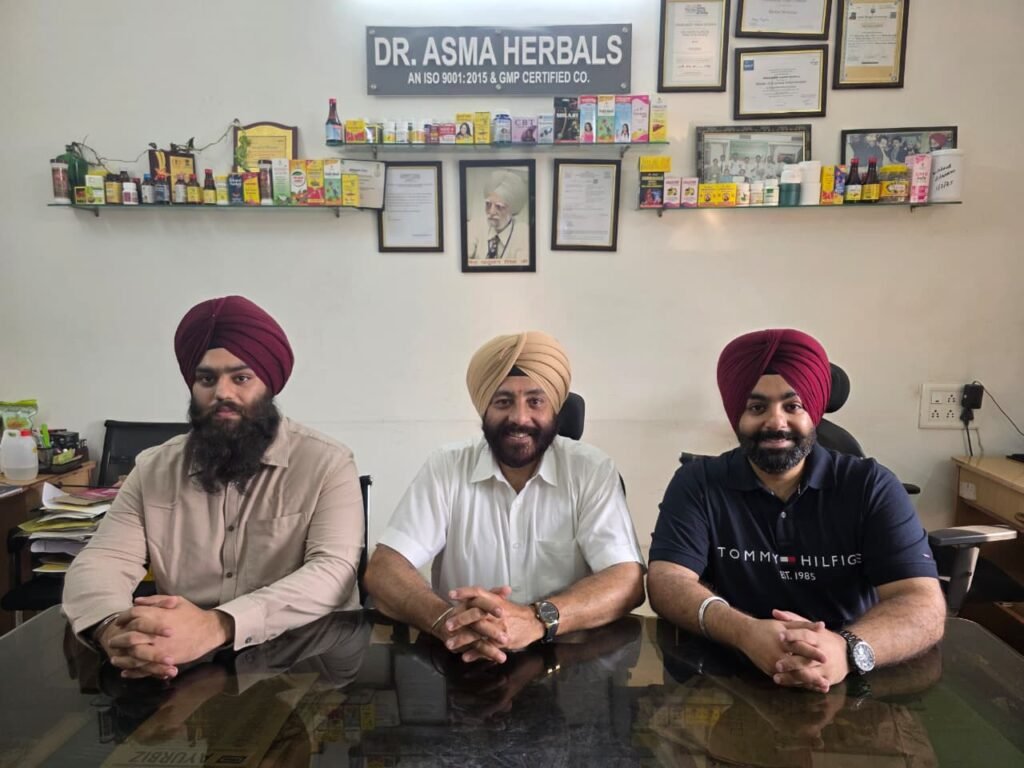
Founded in 1972 and currently in its third generation of family leadership, Dr. Asma Herbals is a GMP and ZED-certified Ayurvedic manufacturer based in Amritsar, Punjab, operating in close proximity to the Jammu and Kashmir herbal sourcing corridor. The company produces over 250 classical Ayurvedic formulations including Bhasmas, Arishtas, Asavas, Churnas, Tailas, tablets, and capsules, and currently exports to Canada, Germany, and Hong Kong.
With more than five decades of formulation expertise, a fully certified production facility, and an established export track record, Dr. Asma Herbals represents the manufacturing depth and reliability that international private label brands seek when entering the Indian Ayurvedic supply chain.
Conclusion
The private label Ayurveda boom is not a passing trend. It is a structural shift in how global wellness brands operate and where they source their products. India’s position at the centre of this shift is not accidental — it is the result of centuries of botanical knowledge, decades of manufacturing investment, and a growing ecosystem of certified producers ready to serve international demand.
For the Jammu and Kashmir region specifically, this moment presents a dual opportunity — as a source of premium, traceable botanical ingredients for the global Ayurvedic supply chain, and as a potential manufacturing destination for the next generation of certified herbal producers.
For international brands looking to enter or expand in the natural health space, the question is no longer whether to source from India. It is which Indian manufacturer has the experience, certifications, and production capacity to be a long-term partner.
And for Indian manufacturers who have quietly built that capability over generations, the global market is finally ready to recognise what they have always been able to offer.
For private label Ayurvedic manufacturing inquiries and export partnerships, visit asmaherbals.co.in.