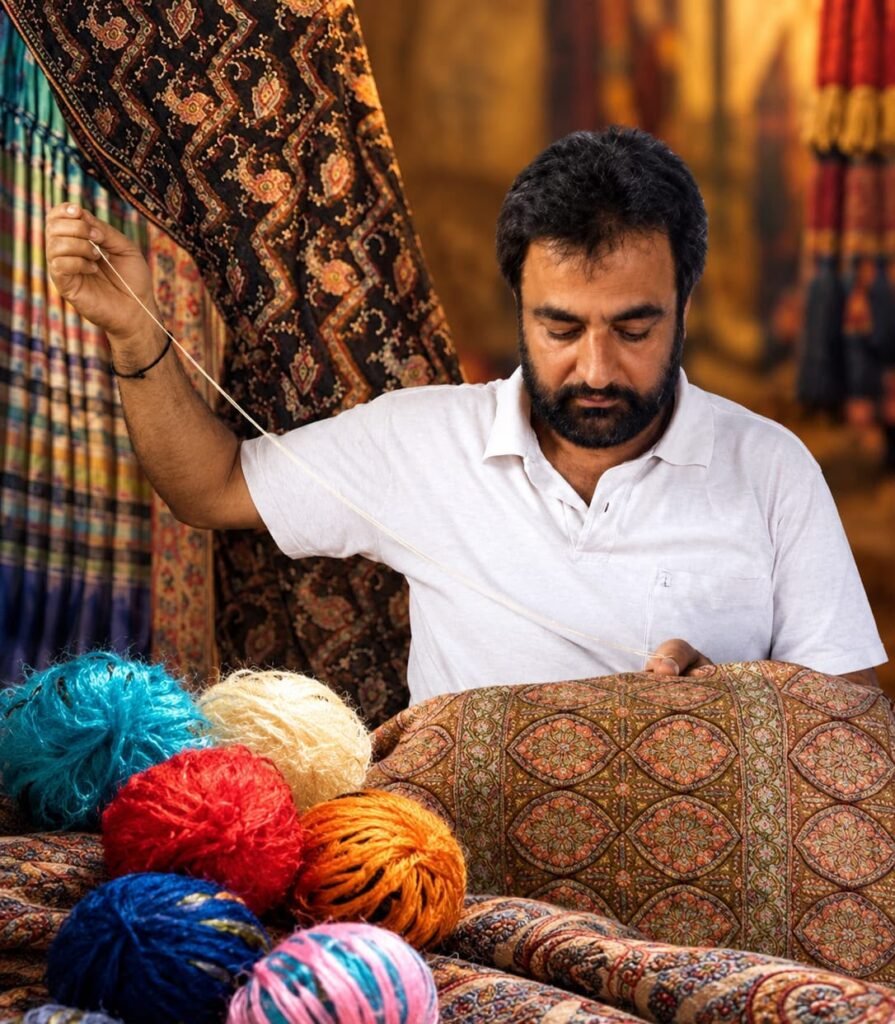
SRINAGAR: Behind the intricate patterns of Kashmiri Sozni embroidery lies a world of patience, precision and years of practice. For Mohammad Iqbal Ganie, the craft is not simply a profession. It is a family legacy that began in childhood and gradually became the defining journey of his life.
A science graduate by education, Ganie chose a path far removed from the conventional career options available to him after completing his studies. Instead of leaving behind the craft he had grown up watching, he decided to build his life around Sozni embroidery and the knowledge passed down to him by his father, Ghulam Mustafa Ganie.
“I learnt this craft not in a classroom, but in my childhood, sitting beside my father, Ghulam Mustafa Ganie. He was an incredible artisan,” Ganie recalls.
Those early years, spent watching his father’s needle move across delicate fabric, eventually developed into a deep interest in the craft. During his college years, that interest turned into a conscious decision to continue the family’s artistic tradition.
The patience behind Sozni
Sozni is among Kashmir’s most intricate forms of traditional embroidery. Created with a fine needle and carefully selected threads, the work is known for its delicate motifs and extremely detailed execution.
Unlike machine-produced embroidery, traditional Sozni depends almost entirely on the artisan’s hand, concentration and experience. A complex piece can take months of work, with some highly detailed creations requiring considerably longer.
For Ganie, choosing the craft meant choosing a profession that demands patience every day. His decision was also closely connected to his relationship with his father and his desire to ensure that the knowledge he had inherited did not disappear with one generation.
Recognition for years of craftsmanship
Ganie’s work eventually earned recognition at both the state and national levels.
In 2005, he received the State Award for Sozni Embroidery, recognising his contribution to the traditional craft.
His journey reached another significant milestone in 2011, when he received a National Award for excellence in Sozni work, further establishing his name among recognised practitioners of the craft.
His contribution was recognised again in 2021, when, on the occasion of Independence Day, he was honoured by the Department of Handicrafts and Handloom as a Best Craftsman in the Sozni craft sector.
For an artisan who began learning the craft at home, these recognitions represent more than individual achievements. They also underline the importance of traditional skills that continue to survive through individual practitioners and artisan families.
Beyond his own work
Ganie’s contribution to Sozni extends beyond the pieces he creates himself. Over the years, he has worked as a trainer and educator, helping others learn the techniques associated with the craft.
According to information about his work, he has trained more than 500 artisans through government and semi-government programmes and institutions.
He has also represented Kashmiri Sozni craftsmanship at various national and international platforms, taking the traditional art beyond its place of origin and introducing it to audiences in different parts of the world.
For a craft whose survival depends heavily on the transfer of knowledge from experienced artisans to younger generations, this training role is particularly significant.
Keeping a tradition alive
The challenge facing traditional handicrafts today is not simply competition from machine-made products. It is also the question of whether younger generations will continue to devote the time required to master crafts that can take years to learn.
Sozni embroidery demands exactly that kind of commitment. Every design is built through countless individual stitches, and the quality of the finished work depends on skills that cannot easily be acquired overnight.
Ganie’s journey illustrates one way in which traditional craftsmanship can remain relevant in a changing economy. His academic background did not prevent him from pursuing an inherited skill. Instead, his education and experience have existed alongside his work as an artisan, trainer and promoter of Kashmir’s handicraft heritage.
His story is therefore not simply about moving from a science degree to embroidery. It is about choosing to preserve knowledge that might otherwise become increasingly difficult to pass on.
For Ganie, Sozni represents both livelihood and responsibility. The needle and thread are tools of his profession, but they also connect him to the generation that taught him and to the generations he hopes to train.
As Kashmir’s handicraft traditions continue to evolve, artisans such as Mohammad Iqbal Ganie remain important custodians of techniques that have been shaped over generations. Their work keeps alive not only patterns and designs, but also the patience, discipline and cultural memory embedded in every handmade piece.
From learning beside his father to receiving recognition for his craftsmanship and training hundreds of other artisans, Ganie’s journey reflects a simple progression: from inheritance to skill, from skill to recognition, and from recognition to responsibility.
For him, the work continues one stitch at a time.