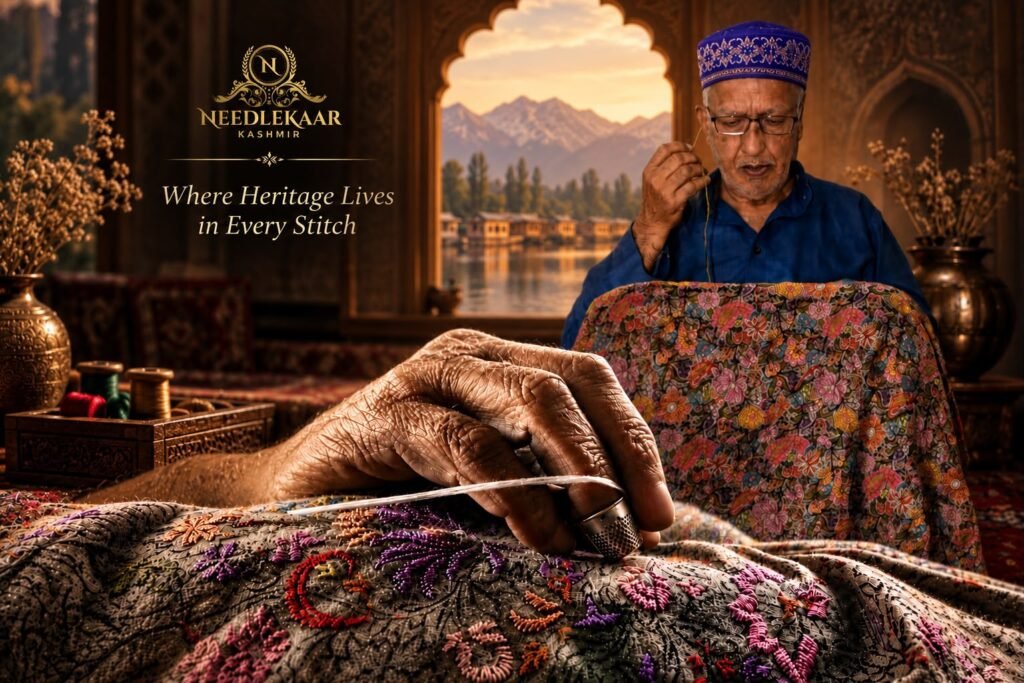
Srinagar: In Kashmir, some traditions survive not because they are preserved in museums or written about in history books, but because people continue to practise them every day.
Kani Sozni is one such tradition.
For generations, Kashmiri artisans have transformed fine Pashmina textiles into intricate works of art, creating flowers, paisleys, geometric patterns and designs inspired by nature. But behind the beauty of these creations lies a craft that demands extraordinary patience, precision and years of experience.
At a time when traditional handicrafts are facing changing consumer preferences, mechanisation and declining interest among younger generations, Needlekaar Kashmir is working to keep this centuries-old craftsmanship connected to the present.
Founded by veteran master craftsman Ghulam Muhammad Ganai, whose journey in the craft spans more than five decades, Needlekaar has grown out of a family tradition that has continued for four generations in Srinagar. For the Ganai family, the craft represents more than a profession passed down from one generation to another. It is a responsibility to protect the knowledge, techniques and artistic language associated with Kashmiri craftsmanship.
An Art That Takes Time
The real story of Kani Sozni begins with patience.
Using a fine needle, artisans work carefully, stitch by stitch, creating intricate patterns while maintaining symmetry, proportion and detail. A single shawl can take years to complete, depending on the intricacy of its design and the amount of handwork involved.
That is why the finished piece represents far more than thread and fabric. It carries years of labour, skill, memory and knowledge accumulated through generations.
Traditionally, Kani refers to the small wooden bobbins associated with Kani weaving, while Sozni refers to the delicate needle embroidery practised on fine textiles. The Ganai family’s expertise includes an understanding of traditional motifs, proportions, symmetry and the visual character of the craft, which they continue to reproduce through meticulous hand embroidery.
Five Decades of Experience
At the centre of this family legacy is Ghulam Muhammad Ganai.
With more than 50 years of experience, Ganai has developed an intimate understanding of Kashmiri embroidery. His knowledge extends beyond the technical use of needle and thread to the precision, motifs, symmetry and cultural symbolism embedded in traditional designs.
For him, preserving a traditional craft does not necessarily mean keeping it frozen in the past. It also means finding ways for the craft to remain relevant while protecting the authenticity that gives it its identity.
That approach forms an important part of Needlekaar Kashmir’s work. The initiative seeks to connect traditional artisan communities with contemporary luxury markets, bringing Kashmiri craftsmanship to modern consumers without compromising the techniques and cultural character behind the work.
When Craft Becomes a Livelihood
There is another important part of the Needlekaar story: the people behind the craft.
Under the guidance of the Ganai family, approximately 850 local artisans have been trained in traditional Sozni techniques. Particular attention has been given to creating opportunities for women in rural communities, including widows, allowing them to earn an income while working from their homes.
For many artisans, such work represents more than a source of income. It can provide independence, dignity, confidence and recognition for skills that have traditionally remained within families and communities.
In this sense, the needle becomes more than a tool of embroidery. It becomes a means of economic participation and self-reliance.
This approach also shifts attention from the finished shawl or textile to the person who created it—the artisan whose time and expertise make the work possible.
Keeping a Heritage Alive in a Changing World
Traditional handicrafts across the world are facing a difficult question: how can skills that have survived for centuries remain relevant in a rapidly changing economy?
For Kashmiri crafts, the challenges include mechanisation, changing consumer preferences, declining interest among younger generations and the largely unorganised nature of the handicraft sector.
The challenge is therefore not simply to preserve Kani Sozni as a piece of cultural history.
It is to ensure that the people who possess this knowledge can continue to build a livelihood from it.
Needlekaar Kashmir’s approach is built around this idea—that heritage has a better chance of surviving when the artisans who carry it forward can also see a future in their craft.
The objective is to create an environment where craftsmanship remains economically meaningful, artisans are respected for their expertise and younger generations can see opportunities in the skills inherited from their families.
A Tradition Still Being Chosen
The story of Needlekaar Kashmir and the Ganai family is ultimately a story about people.
It is found in the quiet concentration of an artisan working on a piece of Pashmina, in the movement of a needle guided by years of experience and in the careful recreation of motifs passed down through generations.
That is what makes Kani Sozni more than just an old craft.
It is a tradition that continues to be practised, taught and given a place in contemporary life.
Needlekaar Kashmir’s journey shows how cultural heritage, artisan livelihoods and contemporary markets can exist alongside one another. An ancient craft does not necessarily have to remain confined to the past. With opportunities for artisans and continued transmission of knowledge, it can remain a living part of Kashmir’s cultural identity.
Sometimes, preserving a culture begins with something very small—a single stitch.
One artisan preserves a skill.
One generation passes it to the next.
And together, they keep a piece of Kashmir’s legacy alive.