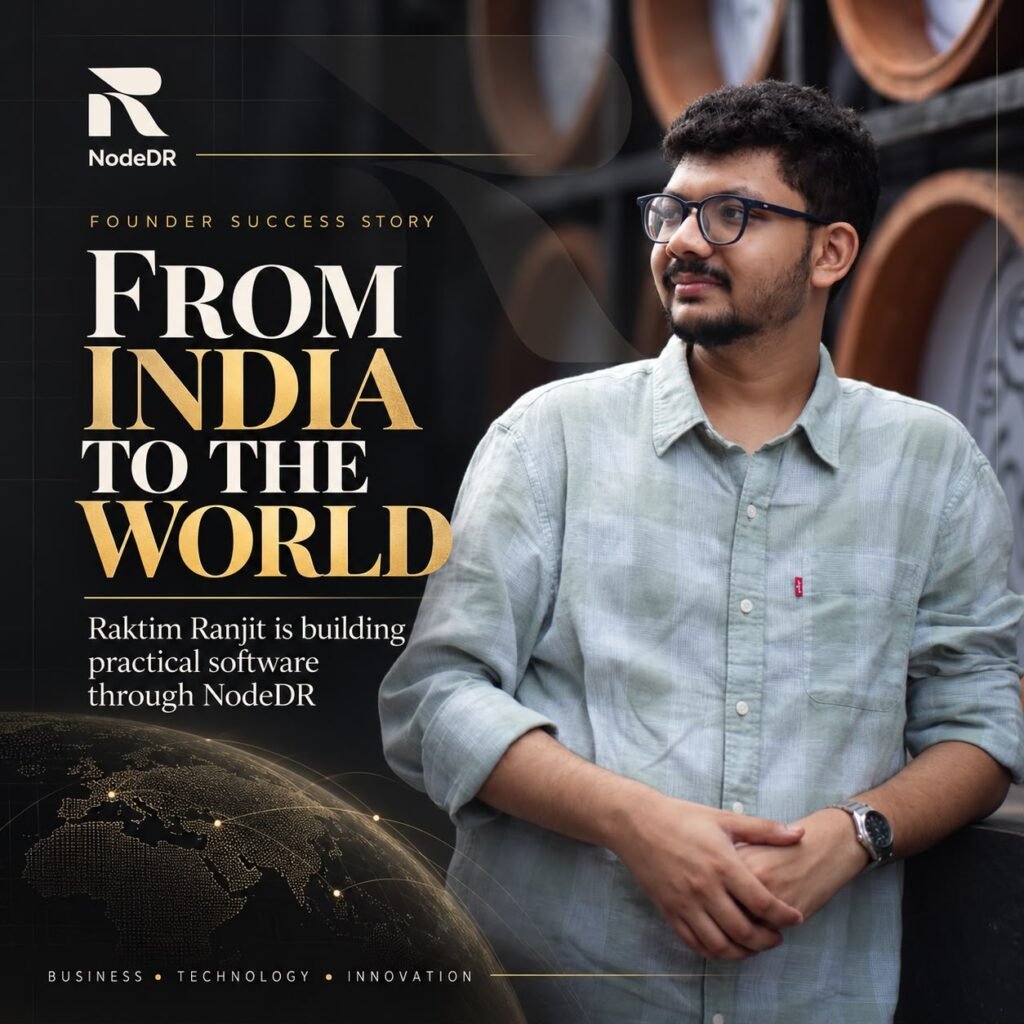
The Indian software entrepreneur is developing a portfolio of business applications, open-source projects and digital solutions aimed at simplifying everyday operations and giving businesses greater flexibility in how they use technology.
In a retail shop, a billing error can affect inventory and customer accounts. In a restaurant, a delayed order can disrupt coordination between the service counter and the kitchen. In a growing company, disconnected applications and spreadsheets can turn routine administrative work into a complicated process.
These may appear to be ordinary business problems, but solving them reliably requires more than writing code or designing an attractive interface. It demands an understanding of how people work, how information moves between systems and what happens when technology fails.
For Raktim Ranjit, founder of NodeDR Infotech Private Limited, these practical challenges form the starting point of his approach to software development. Through NodeDR, he is working on a range of business applications and digital tools covering retail, restaurant management, accounting, workforce operations, pharmacy administration and developer infrastructure.
According to information shared through his official website and the company’s published materials, the broader objective is to develop software that addresses practical business requirements while offering greater flexibility in deployment, ownership and everyday use.
His ambition reflects a wider opportunity for India’s technology sector: building software products that can serve not only domestic businesses but also customers in international markets.
Building Technology Around Real Business Needs
Modern software has transformed how businesses manage their operations. Yet, for many small enterprises, adopting digital tools can still involve significant challenges. Multiple subscriptions, fragmented records, internet dependency and complicated workflows can make technology difficult to manage, particularly for organisations without dedicated IT teams.
Ranjit’s work through NodeDR focuses on this gap between the availability of technology and its practical implementation.
As outlined on his professional website, his approach involves considering the complete system behind an application, including its database, business logic, security, deployment and maintenance. The emphasis is on developing solutions around the workflow they are intended to support rather than treating software as a collection of disconnected features.
Consider a billing application. Beyond generating an invoice, it may need to update inventory, calculate applicable taxes, record a transaction and maintain accurate customer balances. If these processes do not work together, a business can end up with inconsistent records despite using modern software.
It is this interconnected side of software development that NodeDR’s portfolio seeks to address, according to the company’s published product information.
A Software Portfolio Spanning Multiple Industries
NodeDR’s website lists several products designed for different operational environments, each focusing on a particular set of business requirements.
NodeDR POS is designed for retail billing and inventory management. According to its published feature descriptions, the application supports functions such as barcode-based checkout, stock tracking, customer credit records and GST-related pricing workflows. Its offline-first and self-hosted approach is intended to support retailers who need greater independence from continuous internet connectivity.
OrderRestro focuses on restaurant operations, bringing together point-of-sale functionality, table management, reservations, kitchen display workflows and QR-code ordering. The product is intended to help coordinate activities between customer-facing services and kitchen operations.
Rechvix addresses billing, inventory and accounting requirements. Its published documentation describes features including double-entry accounting and inventory movement records, designed to help businesses maintain consistency between financial transactions and stock-related information.
Zulivio focuses on customer relationship management and workforce operations, while KinetiRx is designed for pharmacy and clinic administration. Submify offers a self-hostable approach to receiving and managing website form submissions, addressing a common requirement for developers building websites and web applications.
The portfolio also includes Mavri, which focuses on invoicing and quotations, and NodeDR Construction ERP, designed around construction-related workflows such as material requests, approvals, consumption and budget tracking.
These descriptions are based on information published by NodeDR and should be understood as the intended scope of the respective products. Their practical capabilities and suitability will depend on the specific implementation and business requirements.
Taken together, the applications reflect an effort to address different operational challenges through specialised software rather than relying exclusively on general-purpose business platforms.
Why Offline-First and Self-Hosted Software Matter
One of the recurring themes in NodeDR’s published product information is its emphasis on offline-first functionality and self-hosted deployment.
For businesses operating in areas with unreliable connectivity, dependence on a continuous internet connection can become an operational concern. A retailer may need to continue billing customers, while a restaurant may need to keep orders moving even when its connection is interrupted.
Offline-first software can help by allowing supported operations to continue locally. Self-hosted deployment, meanwhile, can give organisations greater control over where their data resides and how their systems are managed.
NodeDR presents these approaches as alternatives for businesses seeking flexibility beyond conventional cloud-based software arrangements.
There are trade-offs, however. Self-hosted systems require appropriate security measures, backups, updates and recovery planning. Offline functionality also needs careful engineering to maintain data consistency, particularly when multiple devices or systems are involved.
The value of these approaches therefore depends not simply on whether a product offers them, but on how reliably they are implemented and maintained.
For smaller businesses, the underlying proposition is straightforward: technology should accommodate the realities of their operations rather than force every organisation into the same infrastructure model.
Open Source and the Question of Software Ownership
Open-source software is another element of NodeDR’s stated development approach. The company’s published materials identify several projects as open-source offerings, providing developers and technically capable organisations with alternatives to software that can only be used through a proprietary service.
Depending on the applicable licence, open-source applications may allow users to inspect source code, adapt functionality and deploy software within their own infrastructure.
For businesses concerned about vendor dependence, this flexibility can be valuable. It can also make it easier for developers to examine how a system works or customise it for specialised requirements.
However, open-source availability does not automatically guarantee lower costs, better security or long-term support. Those benefits depend on licensing conditions, code quality, maintenance practices and the technical resources available to operate the software.
NodeDR’s interest in open-source and self-hosted approaches, as reflected in its published project information, places software flexibility and control among the considerations informing its portfolio.
Engineering Beyond the User Interface
Ranjit’s professional website provides further insight into the engineering principles associated with his work. His documented interests span application development, system architecture, database design, access controls, deployment infrastructure and software security.
His approach, as described on the website, considers the complete lifecycle of an application, from understanding a business workflow to designing its underlying data structures and maintaining the system after deployment.
One example is the company’s published documentation for Rechvix, which describes the use of database transactions for invoice finalisation and records for inventory movements. Such mechanisms are intended to help ensure that related business operations remain consistent.
These technical details may not be immediately visible to users, but they can be important when software supports financial records, stock management and other business-critical processes.
NodeDR also lists custom software development among its services, including websites, e-commerce applications, SaaS platforms, APIs, automation and maintenance of existing codebases.
This combination of product development and customised engineering gives the company a framework for addressing both recurring business needs and requirements that may not fit neatly into an off-the-shelf application.
The long-term challenge, as with any software venture, is to maintain product quality, provide dependable support and demonstrate value in real operating environments.
Beyond Software: Writing and Creative Pursuits
Ranjit’s professional interests extend beyond technology. His personal website also features writing and photography, offering another perspective on his work outside software engineering.
His listed literary works include A Shoreline for the Unfinished, a romance, and the psychological thriller series Proof of Absence. The subjects associated with these works explore themes such as memory, evidence, grief and human experience.
His website also documents technical writing related to software architecture, engineering decisions and security.
These creative and technical pursuits occupy different spaces, but together they illustrate a professional profile that extends beyond application development. While software engineering is concerned with designing systems that function reliably, creative writing offers a different way to explore structure, ideas and human behaviour.
Readers interested in his work can consult his official website for information about his books and other published material.
An Indian Technology Venture With a Wider Ambition
Building a portfolio of software products is only the beginning. Sustainable growth also depends on customer adoption, product reliability, security, documentation, ongoing maintenance and the ability to compete with established alternatives.
For NodeDR, the opportunity lies in serving businesses that need software suited to their operational requirements, with flexibility in how applications are deployed, managed and maintained.
The broader ambition described by Ranjit is to develop practical software in India with the potential to reach international markets. Achieving that objective will depend on how effectively the products meet customer expectations and establish a sustainable presence in their respective categories.
India’s technology industry has built a substantial presence in software services and engineering. Developing products that can compete across markets represents another avenue for Indian entrepreneurs seeking to build long-term technology businesses.
Through NodeDR, Ranjit is pursuing that direction with a portfolio spanning specialised business applications, open-source projects and custom software development.
The significance of this effort will ultimately be measured by the problems the products solve, the businesses they serve and their ability to remain reliable as those businesses grow.
For now, the underlying principle guiding the venture is practical: understand the problem, build the appropriate technology and make it useful to the people who depend on it.